
How to Choose the Right Martial Arts School for Your Child in San Diego
Choosing a martial arts school for your child is a decision that deserves careful consideration. Martial arts can be much more than a physical activity. With the right program, children can develop confidence, discipline, focus, coordination, respect, and valuable life skills.
For parents in San Diego, finding the right school can sometimes feel overwhelming. There are many programs, instructors, martial arts styles, schedules, and training environments to consider. The school that works well for one child may not necessarily be the right fit for another.
Before enrolling your child, take some time to understand what makes a martial arts program a good choice for children and what factors are most important for your family.
Think About What You Want Your Child to Gain
Every child has different reasons for starting martial arts.
Some children are naturally interested in learning martial arts techniques. Others may need an activity that gets them away from screens and encourages them to be physically active. Parents may be looking for a program that helps their child become more confident, focused, respectful, or disciplined.
Think about your child’s individual needs before choosing a school.
You may want a program that helps your child:
- Become more confident
- Improve physical fitness
- Develop better concentration
- Learn age-appropriate self-defense skills
- Become more disciplined
- Improve coordination and balance
- Make new friends
- Develop perseverance
- Become more comfortable in social situations
Once you know what you want your child to get from martial arts, it becomes easier to compare different programs.
Visit the Martial Arts School
Pictures and information on a website can give you an idea of what a school offers, but visiting the facility can tell you much more.
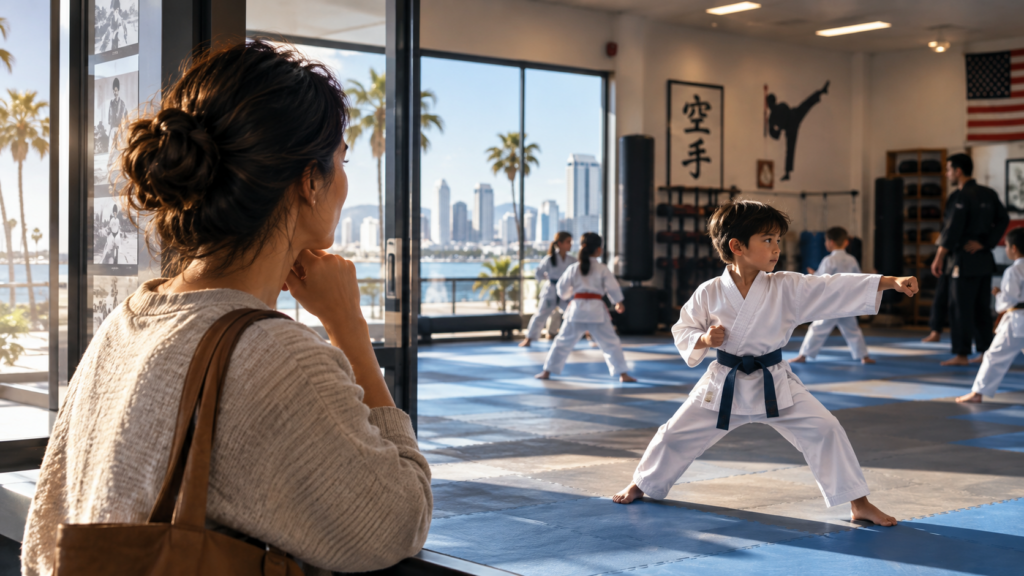
Try to observe a class while you are there. Pay attention to the way instructors communicate with students and how children respond to them.
Do the students look engaged? Are instructors patient when a child struggles with a technique? Is the class organized? Does the environment feel welcoming?
You should also look at the training area. It should be clean, organized, and suitable for children’s activities.
A positive atmosphere can make a major difference in your child’s experience.
Meet the Instructors
The instructor may have one of the biggest influences on your child’s martial arts journey.
A skilled martial artist isn’t automatically a great children’s instructor. Teaching young students requires patience, communication, consistency, and an understanding of how children learn.
When you meet an instructor, ask about their martial arts background and experience working with children.
Watch how they interact with students. A good instructor should be able to maintain classroom rules while still encouraging children to enjoy learning.
The ideal balance is structured but supportive. Children should understand that training requires effort while also feeling comfortable making mistakes and asking questions.
Find an Age-Appropriate Program
Children of different ages have different physical abilities, attention spans, and learning needs.
A good martial arts school should have classes that are appropriate for the child’s age and experience level.
Younger children may spend more time learning basic movements, balance, coordination, listening skills, and following instructions. Older children may be ready for more advanced techniques, conditioning, partner drills, and other challenges.
Ask the school how it groups students and whether beginners train separately from more experienced students.
A well-organized class can help your child learn at a comfortable pace without feeling overwhelmed.
Explore Different Martial Arts Styles
There are several martial arts styles available to children, and each can offer a different training experience.
Karate often combines striking techniques, forms, coordination, discipline, and traditional martial arts principles.
Taekwondo places significant emphasis on kicking techniques, movement, flexibility, balance, and athletic development.
Brazilian Jiu-Jitsu focuses primarily on grappling, positioning, technique, and controlling an opponent.
Other martial arts can have their own approaches and benefits.
There is no universal answer to which martial art is best for every child. Your child’s personality, interests, age, and goals should all play a role.
If possible, let your child watch or try a class before deciding.
Consider the Location and Schedule
Consistency is important when children participate in martial arts. Even a great program can become difficult if getting there is inconvenient.
San Diego is a large area, so consider how long it will take your family to travel to the school during your normal routine.
Look at the available class times and determine whether they work with school, homework, family responsibilities, and other activities.
A convenient location and realistic schedule can make it easier for your child to attend regularly.
Before signing up, ask about evening and weekend classes, make-up classes, holiday schedules, and other policies that could affect your family’s routine.
Make Safety a Priority
Parents should always ask questions about safety before enrolling a child in martial arts.
Martial arts training can involve physical activity and, depending on the program, controlled contact. The school should have appropriate safety procedures in place.
Ask how instructors supervise students and how physical contact is introduced. Find out whether protective equipment is required for certain activities and how the school handles injuries or emergencies.
The goal should be to teach children how to train responsibly and safely.
A good program should help children understand control rather than encourage unnecessary aggression.
Look for a Healthy Approach to Discipline
Discipline is one of the reasons many parents choose martial arts for their children. However, healthy discipline should be based on consistency, responsibility, and respect rather than fear.
Children can learn to listen carefully, follow instructions, practice regularly, control their emotions, and keep working when something is difficult.
A good instructor can correct inappropriate behavior without embarrassing or humiliating a child.
Martial arts training should help children understand that discipline is about controlling their actions and making better choices.
These lessons can eventually carry over into school, home, sports, and other parts of everyday life.
Ask About the School’s Teaching Philosophy
Every martial arts school has its own approach to training.
Some programs place a strong emphasis on traditional martial arts. Others focus more heavily on fitness, competition, self-defense, or personal development.
Ask the instructor what they want students to learn beyond physical techniques.
You may find that some schools place significant importance on qualities such as:
- Respect
- Self-control
- Responsibility
- Perseverance
- Confidence
- Courtesy
- Focus
- Leadership
For many parents, these character-building lessons are just as important as learning martial arts techniques.
Pay Attention to Your Child’s Reaction
Parents should listen to their children when choosing an activity.
After visiting a school or attending a trial class, ask your child what they thought about the experience.
Did they enjoy the class? Did they feel comfortable with the instructor? Did they like the other students? Would they be interested in coming back?
Your child’s enthusiasm can be an important indicator.
A program may look perfect on paper, but if your child feels uncomfortable or doesn’t enjoy the training environment, they may struggle to stay motivated.
Finding a school where your child looks forward to attending classes can make a significant difference over time.
Understand the Costs
Price is another factor parents need to consider, but it shouldn’t be the only deciding factor.
Before joining, ask the school to explain all of the costs involved. Monthly tuition may not always include everything.
Find out whether there are additional charges for uniforms, equipment, testing, special events, competitions, or private lessons.
You should also understand the cancellation policy and whether the program requires a contract.
Instead of simply choosing the cheapest option, consider the overall value of the program. Instructor experience, class quality, safety, student support, and the learning environment are all important.
Understand How Students Progress
Many martial arts programs use a belt or ranking system to help students track their progress.
Ask how students advance and what they need to demonstrate before moving to the next level.
A well-designed progression system can give children realistic goals and help them understand the importance of consistent effort.
The process can also teach an important lesson: meaningful improvement takes time.
Rather than focusing only on earning the next belt, children should learn to appreciate the skills and habits they develop along the way.
Watch for Warning Signs
Parents should feel comfortable asking questions and taking their time before making a commitment.
Be cautious if you notice an environment where instructors frequently embarrass children, safety procedures are unclear, or students are encouraged to behave aggressively.
You should also ask questions if the pricing or contract terms are difficult to understand.
The training facility should appear reasonably clean and organized, and instructors should be able to explain how children’s classes are structured.
Most importantly, trust your judgment. If the environment doesn’t feel appropriate for your child, continue looking.
Consider the Long-Term Experience
Martial arts is most beneficial when children have the opportunity to train consistently and gradually improve.
Instead of choosing a school only because it looks exciting on the first visit, think about whether your child could enjoy training there for several years.
A good martial arts program should provide challenges as your child develops. Beginners should have a clear path to continue learning without losing interest as their abilities improve.
Over time, children can develop not only physical skills but also patience, confidence, self-control, and perseverance.
The ultimate goal doesn’t have to be earning a black belt. The real value can come from the habits and character children develop throughout the journey.
Final Thoughts
Choosing the right martial arts school for your child in San Diego is about finding the right combination of qualified instructors, a safe environment, age-appropriate training, convenient scheduling, and positive values.
Take the time to visit different schools, watch classes, speak with instructors, ask about safety and costs, and give your child an opportunity to experience the training.
Most importantly, choose an environment where your child feels comfortable learning, is encouraged to improve, and enjoys coming back to class.
When children find the right martial arts school, training can become more than an after-school activity. It can become a positive part of their development and help them build skills they can carry with them throughout life.
Frequently Asked Questions
What should parents look for in a children’s martial arts school?
Parents should consider instructor experience, student safety, class structure, teaching style, cleanliness, scheduling, costs, and the overall atmosphere. It is also important to choose a school where the child feels comfortable and motivated to learn.
Which martial art is best for children?
There isn’t one martial art that is right for every child. Karate, Taekwondo, Brazilian Jiu-Jitsu, and other styles can all provide valuable benefits. The best choice depends on your child’s age, personality, interests, and goals.
Should my child take a trial martial arts class?
A trial class can be a great way to see whether your child enjoys the school and feels comfortable with the instructor and other students. It can also give parents a better understanding of the teaching environment.
Is martial arts safe for children?
When taught by qualified instructors in an appropriate environment, children’s martial arts programs can provide structured physical activity with safety as an important part of training. Parents should always ask about supervision, protective equipment, and safety procedures.
Can martial arts help children develop confidence?
Martial arts can give children opportunities to set goals, practice new skills, overcome challenges, and recognize their own progress. These experiences can help support confidence and a positive attitude toward learning.